Journal · Spiritual Practice · Long Read
Tarot Card Meanings: A Beginner's Guide to the Major Arcana
Tarot cards are tools for insight, reflection, and self-understanding — not fortune cookies. Here's a beginner's guide to what the cards mean, how to read them, and how tarot connects to astrology.
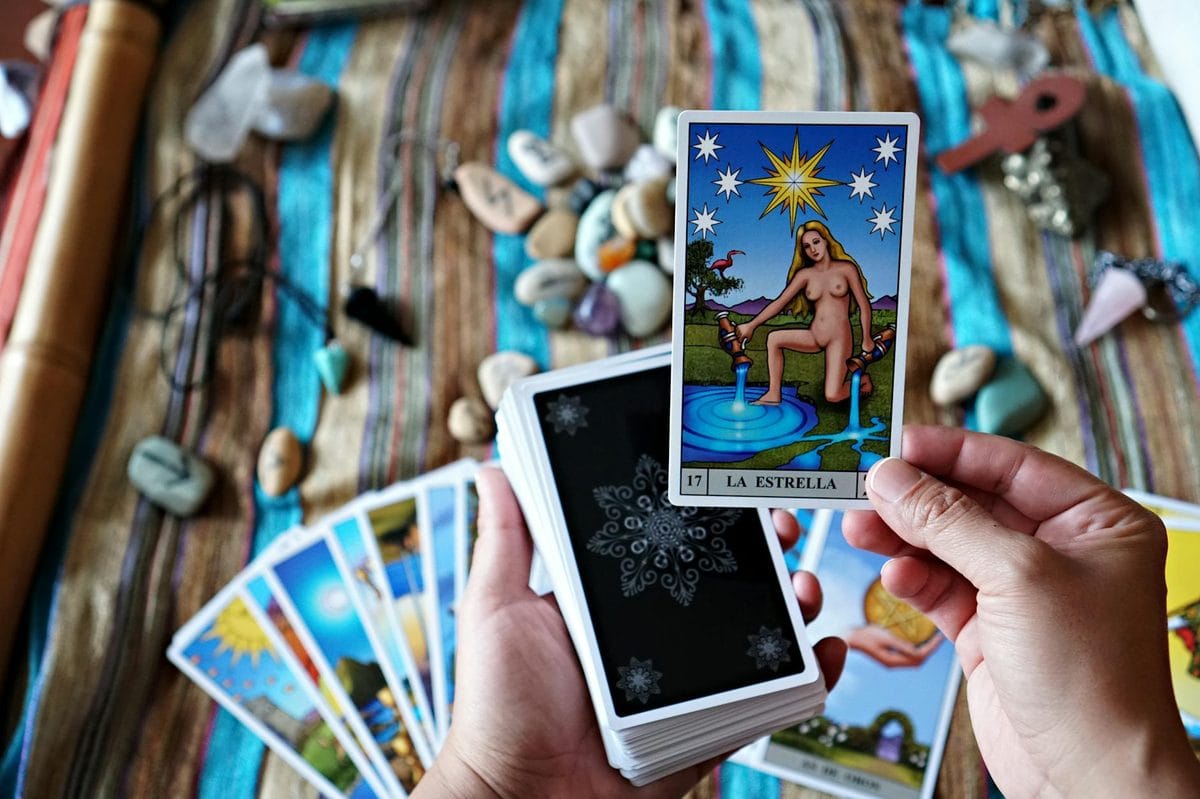
Tarot cards are one of the most enduring tools in the spiritual and divinatory world. They can help you reflect on a situation, gain clarity about a decision, or see a familiar problem from a new angle. If you want to know about your love life, your finances, your family, or your overall path, tarot can offer a surprisingly useful mirror.
Tarot cards also carry significant spiritual and psychological value. They're meant to guide you through a situation by making a symbolic connection to your life and bringing clarity to it. You can learn a lot about yourself by doing tarot readings — and if you play your cards right, you may even glimpse the shape of what's coming. Here's everything a beginner needs to know.
What Is the Meaning of Tarot?
Tarot cards are meant to help you interpret your experience in the spiritual and physical world. They explain your journey, lay out choices, and show the paths you can take. Each card has its own symbolic meaning, and a reading combines those meanings into a story about your situation.
A tarot card reading can give you insight into your spiritual self and teach you what each path in front of you might mean. If you choose to listen to what the cards show, the reading can shift your perspective and sometimes change the way you approach a decision.
The main principles of tarot include:
- Life and death
- Ethical dilemmas and inner choices
- Spirituality and meaning
- Interactions with others and relationships
- The journey of the self
The cards are meant to interact with each other. A spread is more than the sum of its parts — the cards speak to one another, and the story emerges from the combination.
What Can You Use Tarot Cards For?
The main use of tarot cards is to give you insight and perspective. They can speak to your love life, your finances, your family, your friendships, and your overall sense of direction. Spiritual advisors and those who claim psychic ability use them to help clients glimpse possibilities for the future — though the best readings treat the cards as reflective tools rather than fixed predictions.
You'll find tarot readers at New Age conferences, local festivals, metaphysical shops, and of course online. There's long been debate about whether tarot is genuine divination, psychological self-reflection, or something in between. You get to decide what you believe — the cards work for different people in different ways, and both interpretations can coexist.
A Brief History of Tarot
Tarot cards most likely originated in 15th-century Northern Italy as a playing-card game called tarocchi. Early decks like the Visconti-Sforza were commissioned by wealthy Italian families and were used for a game similar to bridge. The cultural influences on the symbolism came from Christian, Hebrew, and hermetic traditions, all swirling through Renaissance Europe.
There's a persistent legend that tarot originated in Egypt — this was popularized in the 18th century by French occultists like Antoine Court de Gébelin and Etteilla, who believed the cards preserved ancient Egyptian wisdom. Modern scholarship has largely disproven that theory, but it shaped how tarot was used for centuries.
At the beginning of the 20th century, the famed occultist Aleister Crowley wrote The Book of Thoth as a companion to the Thoth Tarot deck. Around the same time, Arthur Edward Waite and Pamela Colman Smith created the Rider-Waite-Smith deck (1909), which remains the most widely used tarot deck in the world today. Most beginner decks and online tarot resources are based on the Rider-Waite-Smith imagery.
What Is the Most Powerful Card in the Tarot?
There's no single answer, but The World (card 21 of the Major Arcana) is often considered the most powerful because it represents completion, fulfillment, and wholeness — the end of a journey. The Fool (card 0) is equally significant, as it represents the beginning of every journey and carries the potential of everything that follows. The Wheel of Fortune, The Sun, and The Magician are other strong contenders depending on the question and the reader's tradition.
How to Read Tarot Cards
A standard deck of tarot cards has 78 cards, divided into two parts:
The Major Arcana consists of 22 cards representing major themes and life lessons. These are the cards most beginners learn first: The Fool, The Magician, The High Priestess, The Empress, The Emperor, The Hierophant, The Lovers, The Chariot, Strength, The Hermit, Wheel of Fortune, Justice, The Hanged Man, Death, Temperance, The Devil, The Tower, The Star, The Moon, The Sun, Judgement, and The World.
The Minor Arcana consists of 56 cards divided into four suits, representing everyday life experiences. The suits are:
- Wands — cards of action, creativity, passion, and will (linked to the element of fire)
- Swords — cards of thought, decision-making, conflict, and intellect (element of air)
- Cups — cards of feelings, emotions, relationships, and intuition (element of water)
- Pentacles — cards of finances, work, body, and material life (element of earth)
The Minor Arcana reflects the daily textures of life, while the Major Arcana speaks to the larger arc of your story. A good reading usually includes both.
Your First Tarot Reading: Step by Step
Ready to try a reading yourself? Here's a simple process:
- Choose your deck. The Rider-Waite-Smith is the classic beginner's deck and has the most learning resources available. Many modern decks are beautiful but assume you already know what the cards mean.
- Formulate a question. Open-ended questions work better than yes/no ones. "What do I need to know about my current relationship?" is better than "Will he call me?"
- Shuffle the deck while focusing on your question. Keep shuffling until it feels done.
- Pull your cards. A three-card spread is the easiest way to start. Pull three cards and lay them out left to right.
- Assign meaning to the positions. Common three-card spreads include past/present/future, situation/action/outcome, and mind/body/spirit.
- Read the cards together. Don't just interpret each one in isolation — notice how they interact. A story should emerge.
- Reflect and journal. Write down what you pulled and what you thought it meant. Come back later to see how it played out.
You'll only get better with time and practice. Every reader has their own rhythm — trust yours.
The Major Arcana Meanings (Quick Reference)
Here's a short-form meaning for each of the 22 Major Arcana:
- The Fool — new beginnings, innocence, leap of faith
- The Magician — manifestation, skill, willpower
- The High Priestess — intuition, hidden knowledge, inner wisdom
- The Empress — creativity, abundance, nurturing
- The Emperor — authority, structure, control
- The Hierophant — tradition, teaching, institutions
- The Lovers — choice, relationships, values
- The Chariot — willpower, determination, direction
- Strength — inner strength, courage, compassion
- The Hermit — introspection, solitude, inner guidance
- Wheel of Fortune — change, cycles, fate
- Justice — truth, fairness, cause and effect
- The Hanged Man — surrender, new perspective, pause
- Death — transformation, endings, release (not literal death)
- Temperance — balance, moderation, integration
- The Devil — attachment, shadow, temptation
- The Tower — sudden change, upheaval, revelation
- The Star — hope, renewal, inspiration
- The Moon — illusion, intuition, the unknown
- The Sun — joy, success, vitality
- Judgement — awakening, reckoning, rebirth
- The World — completion, fulfillment, wholeness
How Tarot Connects to Astrology
Tarot and astrology are often used together because they share a symbolic language. Each Major Arcana card is traditionally linked to a zodiac sign or planet — The Emperor with Aries, The Empress with Venus, The Chariot with Cancer, Death with Scorpio, The Star with Aquarius, and so on. The Minor Arcana suits map onto the four elements that astrology also uses. Many readers who work with one eventually learn the other, and the combined system offers powerful layered insight. If you want to explore this connection, start by looking up what a birth chart is and how the symbols overlap.
Reversed Cards: What Do They Mean?
When a card appears upside-down in a reading, it's called a reversed card. Some readers interpret reversals as the shadow, blockage, or opposite of the card's upright meaning. Others treat reversals as a softer or more internalized version of the same energy. Many beginners skip reversals entirely at first and only interpret upright meanings — that's a perfectly valid approach and actually recommended until your fluency with the 78 cards is strong. Once the upright meanings are second nature, reversals add a useful layer of nuance without overwhelming you.
Common Tarot Spreads for Beginners
Beyond the three-card spread, a few common layouts every beginner eventually learns:
- One-card daily pull — a single card drawn in the morning as a theme for the day
- Three-card spread — past/present/future or similar three-part structures
- Five-card cross — a deeper look at a current situation and its influences
- Celtic Cross — the classic ten-card spread for a full-picture reading
- Relationship spread — cards laid out to represent each person and the dynamic between them
Frequently Asked Questions
Can tarot predict the future?
Tarot is better understood as a tool for insight and reflection than as literal prediction. The cards show tendencies and energies at play — what you do with that information is up to you. Many readers believe the future shown in the cards is a possibility, not a fixed outcome.
Do you have to be psychic to read tarot?
No. Tarot is a learnable skill. Anyone can study the cards, develop interpretive fluency, and give useful readings. Intuition helps, but it's trained by practice like any other skill.
Is tarot safe?
Yes. Tarot cards are just printed cardboard — any effect they have comes from your engagement with the symbols. Some religious traditions discourage tarot for theological reasons, but the cards themselves are not dangerous.
How often should I read for myself?
Moderation helps. Daily pulls are fine for reflection, but re-asking the same question over and over muddies your reading. Give a situation time to move before you ask the cards about it again.
What's the difference between tarot and oracle cards?
Tarot is a standardized 78-card system with a fixed structure. Oracle decks are free-form, can have any number of cards, and vary wildly in theme and approach. Both are valid tools — tarot offers more depth and structure, oracle decks offer more intuitive flexibility.
Should I let someone else touch my deck?
That's personal preference. Some readers believe their deck should only be touched by them; others let clients shuffle. Do what feels right for your practice.
Final Thoughts
Tarot cards are meant to bring awareness to a situation — a mirror for your love life, finances, family, or spiritual path. You can get a reading from a professional reader or learn to read for yourself. A good reading offers insight into where you are and the path ahead. Approach the cards with curiosity and patience, and they'll open up more than you might expect.